
Granny Hobbies Are Good for You
A 2024 study found that birdwatching reduced psychological distress more than a regular nature walk. It's the kind of finding that may have surprised us ten years ago. Now it feels almost obvious — because somewhere along the way, younger people stopped waiting for retirement to pick up the hobbies their parents and grandparents saved for later.
More importantly, the people doing them love them. Not because they're nostalgic, but because they feel genuinely good.
Birdwatching, knitting, sourdough, houseplants, gardening, hand-quilting — hobbies that previous generations quietly filed under things you do after you retire — have been reclaimed, enthusiastically and without irony, by millennials, Gen Z, and younger Gen X. The internet loves them. Science is starting to catch up. These hobbies are pleasant and they're doing something specific and measurable inside the nervous system.
What's actually happening when your brain won't quiet down
Most of us have a name for it — the loop, the hamster wheel, the voice that won't stop. Clinically, it's called rumination: the repetitive cycling of the same thoughts, worries, or self-critical commentary. Rumination has a physical signature in the brain — a cluster of activity in a region called the subgenual prefrontal cortex that lights up when we're caught in negative self-referential thinking, and it's closely linked to anxiety and depression.
The question researchers have been asking: what actually interrupts that loop?
The mechanism: fascination and "soft attention"
One of the more durable findings in environmental psychology comes from Attention Restoration Theory, which distinguishes between two kinds of attention. The first is directed attention — the effortful, sustained focus we use for tasks, decisions, and problem-solving. It depletes. The second is involuntary attention, sometimes called fascination — the kind that's captured automatically by things that are interesting without being demanding. A bird landing on a branch. A flower you haven't seen before. The way dough changes texture under your hands.
Fascination restores directed attention. More importantly, it pulls the brain out of the default mode network — the neural circuitry associated with self-referential thought — and into the present, without requiring effort. Your attention shifts to something else in a natural way, rather than requiring you to force or white-knuckle your way to a state of calm.
This is the mechanism behind why birdwatching keeps showing up in the research. A 2024 NC State study compared three groups of college students: one group took regular nature walks, one took the same walks while actively looking for and logging birds using a phone app, and a control group received no instructions. The birdwatching group reported significantly greater increases in positive emotion and significantly greater reductions in distress than the walking-only group. Something about the act of looking for something specific in the environment was doing more than fresh air alone.
The same mechanism appears to be at work with plant identification, wildlife spotting, and even indoor plant care. A 2025 study from the University of Surrey found that tending houseplants helped people going through stressful life events build resilience against rumination — even when they never left the house. The plants gave them something to attend to outside themselves.
The hobbies, and what they're doing
Birdwatching and nature spotting
Binoculars not required. The key is searching for a particular target. Observing a backyard window feeder is a great start. Alternatively, you can step outdoors to see how many unique plants grow on your block. It is this exact specificity of the search that drives the benefits—by keeping your focus directed outward.
Knitting and crochet
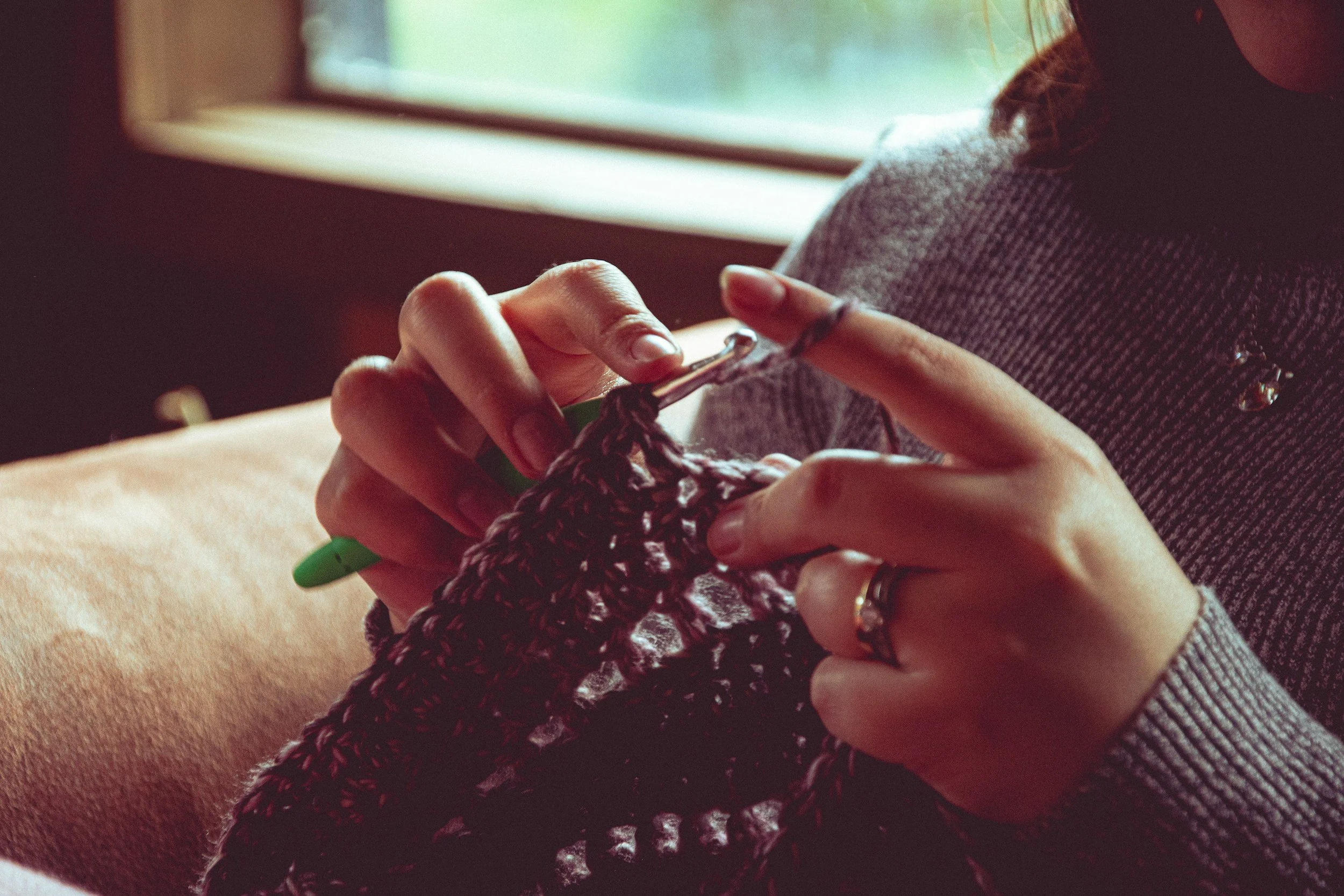
The rhythmic, bilateral, repetitive movement of fiber arts activates the parasympathetic nervous system — the branch responsible for rest and recovery. It also produces a slow, steady release of dopamine that functions very differently from the spikes triggered by scrolling or sugar. A 2024 study published in the Journal of Occupational Science found that people living with mental health challenges described knitting as calming and structuring — two things a dysregulated nervous system is genuinely hungry for.
If you're familiar with EMDR: the alternating, bilateral nature of the hand movements isn't incidental. It's operating on a similar principle.
Gardening
A 2024 systematic review found that gardening increases levels of BDNF — brain-derived neurotrophic factor, sometimes called "fertilizer for the brain" for its role in neuroplasticity and mood regulation. Beyond biology, gardening also works through the fascination mechanism: the environment asks you to pay a certain kind of attention, and that attention crowds out the inner chatter in a way that's almost structural. You're too busy noticing things to stay in the loop.
Baking and cooking
Rhythmic kitchen tasks — kneading, stirring, rolling — activate the parasympathetic nervous system through a similar pathway to knitting. The structure of baking in particular (measured ingredients, defined steps, waiting for the oven) provides what some clinicians describe as containment — a sense of order that can feel genuinely grounding for an anxious mind. There's a reason stress baking is a real thing people do, not just a cliché. The nervous system responds to it.
What these have in common
None of these hobbies require you to think positive, focus on gratitude, or do anything with the content of your thoughts. They work by redirecting attention — either outward toward something in the environment that captures it naturally, or toward a physical, rhythmic task that occupies the parts of the brain responsible for the chatter. They regulate without requiring you to believe anything or fix anything.
Your grandmother may not have had language for any of this but she likely knew that keeping her hands busy helped.
Try one
You don't need to take up all four. Pick the one that sounds the most intriguing to you — the one that might already be in the back of your mind — and give it a few real attempts. Not as a wellness project. Just as something to do that isn't the loop.
If you're finding that anxiety, rumination, or stress feel bigger than a hobby can touch, that's worth talking to someone about.
Sources
Peterson, N., et al. (2024). "Birdwatching linked to increased psychological well-being on college campuses: A pilot-scale experimental study." Environmental Psychology. North Carolina State University. https://www.sciencedirect.com/science/article/abs/pii/S0272494424000793
Bratman, G.N., Hamilton, J.P., Hahn, K.S., Daily, G.C., & Gross, J.J. (2015). "Nature experience reduces rumination and subgenual prefrontal cortex activation." Proceedings of the National Academy of Sciences, 112(28), 8567–8572. https://doi.org/10.1073/pnas.1510459112
Azad, S., & Marselle, M. (2025). "Thriving Through Stressful Life Events with Nature: A Mixed-Method Study on Tending Indoor Plants and Rumination Resilience." International Journal of Environmental Research and Public Health, 22(3), 369. University of Surrey. https://doi.org/10.3390/ijerph22030369
Nordstrand, J., Gunnarsson, A.B., & Häggblom-Kronlöf, G. (2024). "Promoting health through yarncraft: Experiences of an online knitting group living with mental illness." Journal of Occupational Science. University of Gothenburg. https://doi.org/10.1080/14427591.2023.2292281
(2024). "Effect of gardening physical activity on neuroplasticity and cognitive function." Systematic review. Exploration of Neuroscience. https://www.explorationpub.com/Journals/ent/Article/100481
Kaplan, R., & Kaplan, S. (1989). The Experience of Nature: A Psychological Perspective. Cambridge University Press. (foundational source for Attention Restoration Theory)
